TL;DR
Most “Jamaican grabba leaf” isn’t equal. The difference comes down to curing, moisture, and consistency. If the leaf isn’t flexible, evenly colored, and reliable batch-to-batch, it’s not premium—no matter the label.
Related: Wholesale Tobacco Distributor
Prefer Audio? Here’s a Quick Breakdown
If you’d rather listen than read, this short podcast explains Jamaican Grabba Leaf—without the fluff.
🎧 Listen: “Grabba Leaf Jamaica” (Podcast Brief)
Grabba Leaf Jamaica: How to Identify Quality, Avoid Low-Grade Leaf, and Buy with Confidence
1. What Actually Matters When You Buy Jamaican Grabba Leaf
Buyers don’t struggle because there are too few options. They struggle because everything looks the same until you use it.
“Grabba leaf Jamaica” is often marketed as a category, but in reality, it’s a spectrum of quality. The gap between low-grade and high-grade leaf is wide—and most sellers don’t explain the difference clearly.
The only thing that matters is performance:
- Does it stay flexible or crack?
- Does it burn evenly or run?
- Does it taste consistent across batches?
That’s the filter. Not branding. Not packaging. Not claims.
The confusion around grabba vs fronto doesn’t help. They often come from similar tobacco plants, but the preparation changes everything. Fronto is usually whole and lighter. Jamaican grabba leaf is typically darker, stronger, and more commonly used in broken or crushed grabba form.
If you’re searching “grabba leaf near me,” your real question is simpler: which option will perform the same every time you use it?
2. Why Jamaican Grabba Leaf Performs Differently
Not all tobacco leaf behaves the same. Jamaican tobacco leaf has a reputation for strength and burn consistency for a reason—but that only holds if the process is done right.
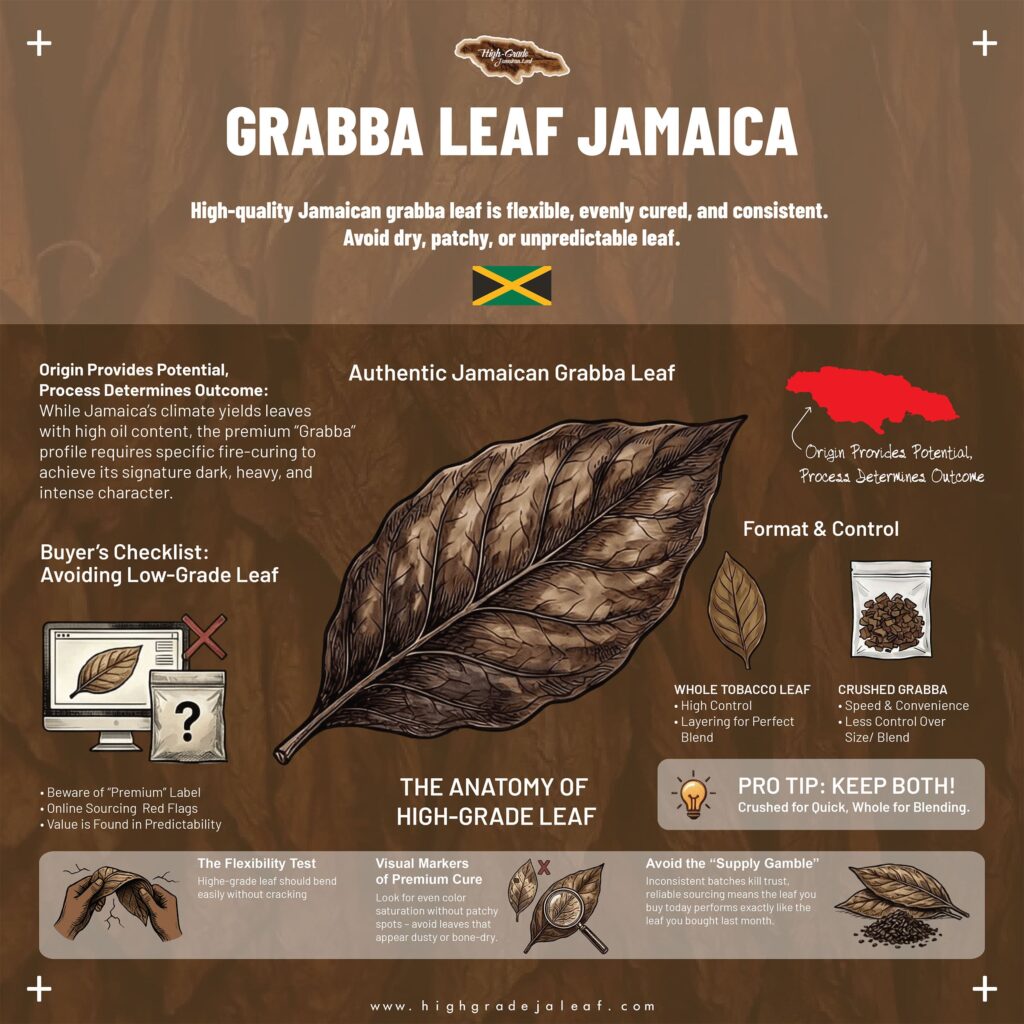
It starts with growing conditions. Jamaica’s climate produces leaves with higher oil content and better elasticity. That’s a performance advantage. But it’s not enough on its own.
Curing is what separates usable leaf from waste.
Air-cured leaf is lighter and milder. Fire-cured leaf creates dark grabba leaf—stronger, heavier, and more intense. Most buyers looking for authentic grabba leaf expect that darker profile.
Where things break down is in execution. Poor curing or rushed drying leads to:
- Brittle texture
- Uneven color
- Harsh, inconsistent burn
At that point, origin doesn’t matter anymore. A poorly handled Jamaican leaf performs worse than a properly handled non-Jamaican one.
The takeaway is simple: origin gives potential. Process determines outcome.
3. Types and Grades: What You’re Actually Paying For
Price differences in Jamaican grabba leaf aren’t random. They reflect how consistent the leaf is—and how much control you have when using it.
Start with format:
- Whole tobacco leaf gives full control. You choose how to cut, layer, and use it.
- Crushed grabba removes prep time. It’s faster, but you give up control over size and blend.
- Broken leaf sits in the middle.
Then look at grade. This is where most buyers misjudge value.
High-grade leaf has three clear traits:
- Flexibility (it bends, doesn’t crack)
- Slight oiliness (not dry, not wet)
- Even color (no patchy curing)
Low-grade leaf fails in at least one of these.
This is where buyers reduce risk. Instead of guessing on loose supply, some choose standardized options, where selection and storage are controlled for repeatable quality. It’s not about branding—it’s about removing variability from the outcome.
Right after purchase is where most inconsistency shows up—mixing formats without control. That’s why experienced buyers often keep a simple working setup on hand:
- Crushed grabba for quick use
- Whole grabba leaf for controlled blending
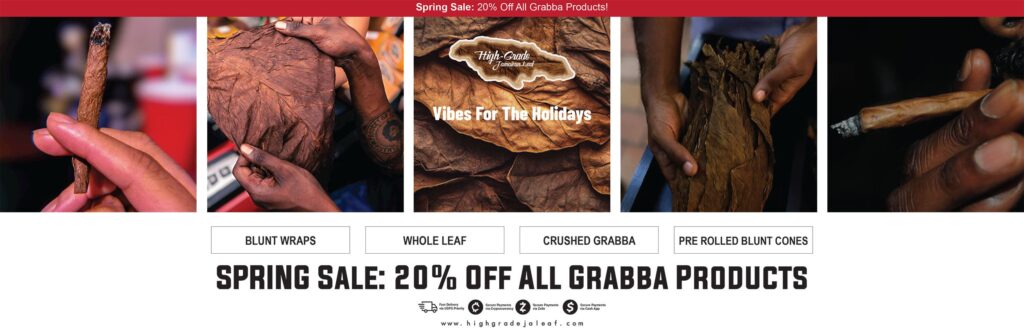
- Blunt wraps for structure
- Pre-rolled blunt cone when speed matters
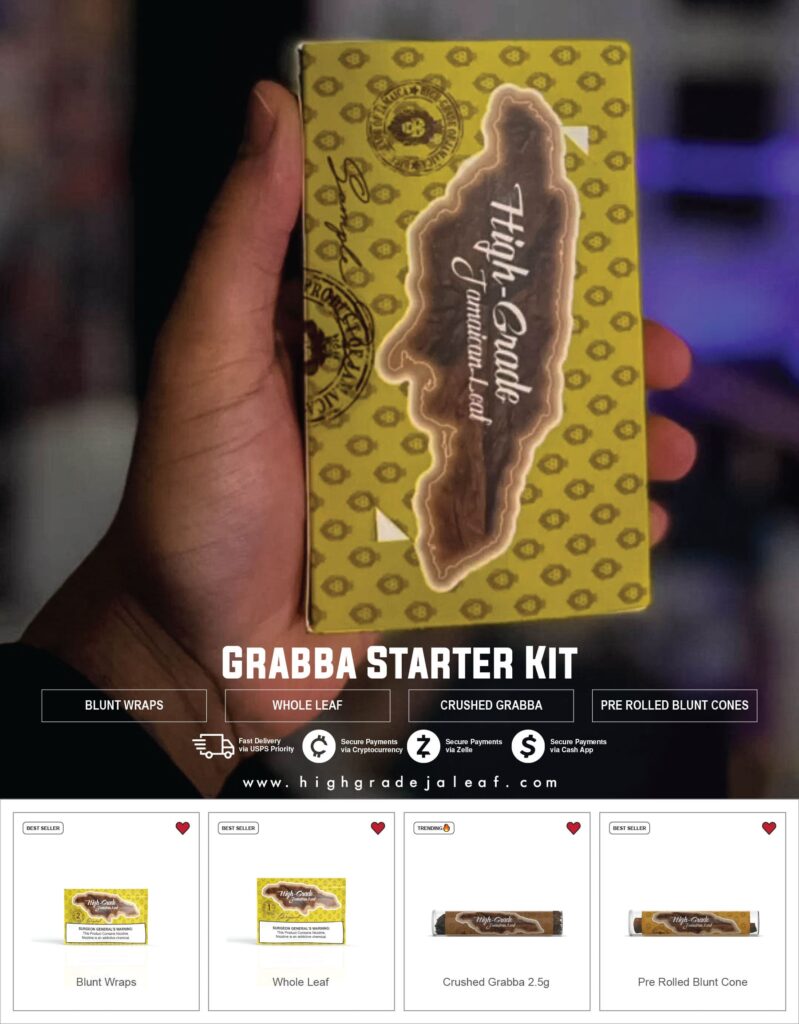
[Check out the Grabba Starter Kit →]
This isn’t about buying more. It’s about isolating variables so you know what’s actually working.
Whole leaf gives control; crushed grabba removes prep time.
4. Where Most Buyers Get It Wrong When Sourcing Grabba
The biggest mistake is trusting availability over evaluation.
Typing “buy grabba leaf jamaica” or “grabba leaf near me” doesn’t solve the real problem. It just shows you what’s accessible—not what’s good.
In local shops, quality depends on turnover and storage. Leaf that sits too long dries out. Leaf that’s over-handled loses structure. If you can’t check flexibility and texture, you’re guessing.
Online, the risk shifts. You can’t touch the product, so you rely on signals:
- Are the images real and consistent?
- Does the seller show the actual leaf, not just packaging?
- Are reviews specific about quality, not just delivery?
Wholesale buyers face a different issue: inconsistency. One good batch followed by two weak ones kills margin and trust.
Reliable sourcing is less about finding the cheapest supplier and more about finding one that delivers the same quality repeatedly.
If the leaf changes every time you buy it, it’s not a supply—it’s a gamble.
5. Pricing, Demand, and How the Market Actually Works
The grabba market is growing, but not in a way that always benefits buyers.
Demand across the U.S., Canada, and the UK has increased. That’s created more supply—but also more repackaging. Many products labeled as premium are standard leaf in better branding.
Pricing typically follows a pattern:
- Whole Jamaican grabba leaf costs more than crushed
- Dark, properly cured leaf costs more than lighter, inconsistent batches
- Reliable supply costs more than one-off deals
Cheap leaf usually fails on consistency. Expensive leaf sometimes fails on value. The middle—consistent, verified quality—is where most informed buyers land.
You’re not paying for the leaf alone. You’re paying for predictability.
Final Takeaway – What Predictable Quality Looks Like
Good decisions in this category are simple, but not easy.
You’re looking for leaf that performs the same way every time. That means:
- Flexible, not brittle
- Evenly cured, not patchy
- Consistent across batches
Basic use: keep the leaf balanced—not too dry, not too moist. Break or layer lightly. Store sealed to maintain consistency.
For more information and to explore High-Grade Jamaican Leaf products, visit:
👉 https://shop.highgradejaleaf.com/
FAQs
Q1: Is Jamaican grabba leaf better than other options?
It can be, but only if it’s properly cured and stored. Process matters more than origin.
Q2: What’s the real difference between grabba vs fronto?
Mostly preparation. Grabba is darker and often broken down. Fronto is usually whole and lighter.
Q3: How do I know if grabba leaf is high quality?
Check flexibility, oil content, and color consistency. Avoid brittle or overly dry leaf.
Q4: Should I choose whole leaf or crushed grabba?
Whole leaf gives control. Crushed grabba saves time. Choose based on how you use it.
Q5: Where should I buy grabba leaf near me?
Look for shops with high turnover or buy from sellers who show real product quality and consistency.
Local Availability – Grabba Leaf Near Me
Looking for Grabba Leaf for Sale?
High-Grade Jamaican Leaf products are available through:
- Convenience Stores
- Gas Stations
- Smoke Shops
- Online Retailers

Shop Grabba Leaf Jamaica→

